레이블이 culture인 게시물을 표시합니다. 모든 게시물 표시

2013년 7월 28일 일요일

[TalkTalk Market] Anyang Seoksu Market


A Place Where Animated Conversations Bloom Along an Alley


TheAnyang SeoksuMarket in Anyang City’s Manandistrict, Seoksu2-dong in GyeonggidoProvince was formed in 1979. Originally a vegetable wholesale market, SeoksuMarket currently has over 40 merchants and 120 stores, of which over 30 are small shops and medium-sized marts. Seoksu Market is centered around a large asphalt parking lot with shops selling various commodities.


During past economic hardships, there was a time when several stores would close down a day. However, beginning 10 years ago artists have moved into the area and have created a space for their creativity. From that point on, artists began creating works of arts by hand in the unused spaces around the market. They transformed spaces that had lost all life into areas overflowing with vitality.


It is easy to find the old buildings and signs from the start of the SeoksuMarket that are still in use today. The market looks as if as if time stood still. You can also find old items full of memories in stores around the market. Decades of life are still intact in the alleys of SeoksuMarket, from a vegetable shop that has been around for 30 years to one grandmother’s rice restaurant.


Bone
haejangguk(hangover soup)began being sold in the market the year it first opened, and it is still one of the top foods of Seoksu Market. With a secret recipe for broth that franchise bone haejanggukrestaurants do not compare to, as well as affordable prices and generous portions, Seoksu Market’s bone haejanggukis popular with everyone regardless of gender or age. As the base for many people’s lives and a part of history, you can feel the unchanging affection of the merchants of Seoksu Market.

2013년 7월 25일 목요일

[Enjoy Food] Goryeo ginseng


While six or seven types of ginseng are known worldwide, the most common types are the Asian Ginseng (PanaxGinseng) grown in Korea and North-East Asia, the American Ginseng (Panax quinquefolium L.) grown in the U.S. and Canada, and the Siberian Ginseng (Eleutherococcus senticosis) grown in China. The Asian ginseng root, whose shape resembles the human body, is categorized as a different species from the American or Siberian types. To distinguish it from other ginseng grown in the world, all of the ginseng cultivated in Korea is referred to as Goryeo ginseng.


Goryeo ginseng is a perennial, shade loving plant, and as mentioned, the root forms “legs” and a “trunk” like a human body. A cultivated ginseng plant can take from four to six years to grow, from selecting the seeds to harvesting, and the more attention given to cultivation, the greater its medicinal effect. Korea has the optimal conditions for ginseng, whose cultivation requires the right natural environment. It is particularly sensitive to climate, to the amount of sunlight, and to soil. Considered a cure for various illnesses even in modern times, Goryeo ginseng has more effectiveness than any other type of ginseng and is effective towards prevention and treatment of most diseases. Because of this, Goryeo ginseng is more expensive than other kinds of ginseng. Sometimes ginseng produced in other countries is remade into Goryeo ginseng.

2013년 7월 23일 화요일

[Fun Fun Market] City tour bus in seoul (traditional market course)


This course departs from Doota and will have a total of 14 stops including traditional markets such as Dongdaemun Market, Namdaemun Market, Gwangjang Market, and Yangnyeong Market and popular areas such as Insadong, and Myeongdong. As buses stop at each destination every 35 minutes, tourists are able to exit the bus at any stop to look around the market and are free to get on the next bus. Audio guides are provided in five languages (Korean, English, Japanese, Chinese, and French).

Ticket prices for the course are 12,000won for adults and 8,000won for teenagers and children.

With the new course added, Seoul City Tour now operates 5 different courses including the City Circulation Course, Night courses I & II, and
Cheongye/Palace Course.


2013년 7월 21일 일요일

[TalkTalk Market] Gyeongdong Market


Gyeongdong Market


GyeongdongMarket started when, after the Korean War, agricultural food vendors from the Northern GyeonnggiProvince and the GangwonProvince gathered in the area to sell their wares. In the 1960s, the market grew rapidly following the completion of a road connecting GangwonProvince with the Seoul area. Medical herbs from GangwonProvince were transported to the market in an ever-increasing number and the market became to specialize in these types of medicinal herbs.


The market sits across several blocks of Jegi-dong and Yongdu-dong in the Dongdaemun-gu district, but it is largely comprised of the Seoul Yangnyeongsi Market, a market selling ginseng, honey, cereals, and medicinal products. The Yangnyeongsi Market is responsible for about 70 percent of the nation’s total distribution of medicinal goods. In addition to other medicinal herbs, visitors can buy things like ginseng, bonnet bellflower, and balloonflower as well as tea ingredients like the fruits of schizandra and cornus, and Solomon's seal (tea ingredients that are hard to find in other parts of the city).

2013년 7월 2일 화요일

[Enjoy Food] Bingddeok (Bing rice cake), Okdom-gui (Broiled sea bream)


Bingddeok (Bing ricecake)

This is known as Bingddeok because it is a rice cake that is made by rolling the dough ‘bing bing’ (round and round). After fine buckwheat powder has been kneaded thinly to prepare round dough, radishes, Welsh onions, salt, sesame powder, and sesame oil are mixed evenly to prepare a filling, and it is placed over a grill. If it is rolled around, it becomes a Bing rice cake. Bing rice cake is eaten from the hand. It is an excellent appetizer when served with a cup of clear rice wine brewed with hulled millet.


Okdom-gui (Broiled sea bream) With a lean and light taste, whoever eats Okdom once will want to try it again. Okdom is a kind of sea bream that is caught only along the coast of Jeju Island and in the seas close to Japan. On Jeju it is known as ‘Saengseon’ or ‘Sollany’. After the Okdom is caught during November to March season, it is spread wide and allowed to dry in half in the sunshine, Okdom paste broiled with sesame oil has an excellent flavor. Since Okdom has a high nutritive value and is a rich source of protein, people with low energy or patients under recovery from illness eat it frequently as a type of porridge.

2013년 6월 23일 일요일

[Talk Talk Market] Nangman Market in Chuncheon


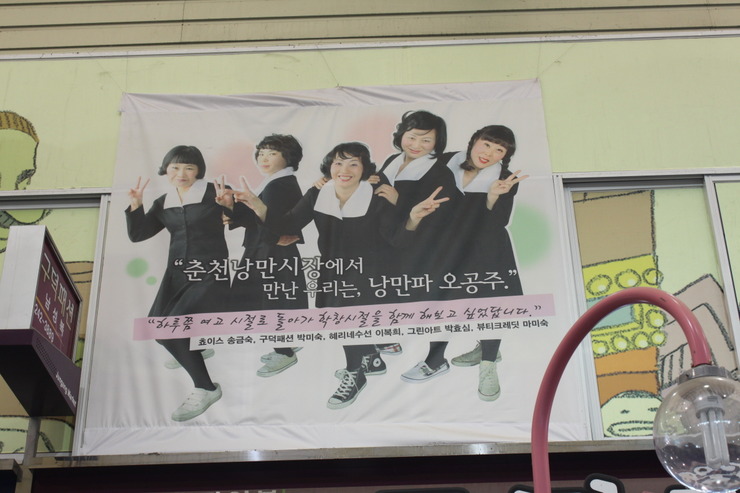
Nangman Market is the new name given to Chuncheon’s first traditional market. Originally called Jungang Market, the market was formed about 60 years ago in the heart of the city following the Korean War. Initially, the market sold manufactured goods from Seoul, American products from the nearby U.S. Army, and local agricultural produce. Gradually, it turned into a large-scale retail market. After experiencing ups and downs caused by the emergence of large-scale marts in the 1990s, Jungang Market’s name was changed into Nangman Market in 2010 to live up to its designation as a culture and tourism market.


Literally meaning ‘a river beckoning spring,’ Chuncheon is referenced in many Korean novels and pop songs as a place of romance and memories. The railway has carried countless travelers to the city for generations. The recent opening of the subway on a double track has shortened travel time to about an hour. The Nangman Market is a nice place to bring back old memories, where people can buy quality products at good prices and enjoy the unique hospitality of a traditional market.


The market is gradually turning into a lively space of culture and art, thanks to its advantageous location in the heart of the city and the enthusiasm of its vendors, cultural activists, and artists. Visitors can enjoy various paintings and formative arts, and have a unique experience in which the whole market turns into a venue for performances. Nearby attractions include Jungnim-dong Church, a modern landmark that’s been in its present location since 1928, Yaksari Pass, which used to be the only road connecting the downtown area with the marketplace, and the old alley where the famed Korean artist Park Soo-keun (1914-1965) spent his youth.
Major shopping items


Food (dakgalbi, toppokki, sundae soup, noodles, etc), clothes, hanbok, bedding)
Nearby attractions : Jungnimdong Catholic Church, Yaksari Pass, Festival Theater Momzit, Artist Park Soo Keun Street
Transportation
Sangbong Station (Subway Line 7, Jungang Line, Gyeongchun Line) -> Namchuncheon Station (Gyeongchun Line)

Take bus #8 or #9 from Namchuncheon Station (travel time: about 10 – 15 min)