레이블이 advantage인 게시물을 표시합니다. 모든 게시물 표시

2013년 8월 8일 목요일

[FunFun Market] jeonju moraenae market


Plentiful Generosity and a Variety of Food


It is fun to choose between the variety of food at the Jeonju Moraenae Market, such as red bean kalguksu, sundae rice soup, whole chicken, Chinese pancakes, and sticky rice donuts. One of the original sundae rice soup restaurants at the Jeonju Moraenae Market is ‘Pi Sundae,’ which is highly known for its unchanging traditional taste for the past 23 years.
 
 
The Gochang Chicken Restaurant, also known as ‘Shijang Tong Dalk’ (Market Whole Chicken), is located inside one of the market’s alleys. This restaurant reminds customers of past memories and stimulates their.


2013년 7월 30일 화요일

[Enjoy Korea] the Seoksu Art Project (SAP). in seock-su market

Finding Hidden Treasures Everywhere the Path Touches

As a new city appeared, the commercial center of Anyang moved to that area, and the atmosphere of Seoksu Market slowly sunk. However, the market’s atmosphere gradually began to change as ‘Stone and Water’entered the area in 2002.


The lonely stores that had lost their function transformed into a kaleidoscopic space, and the merchants and artists’ efforts became a revitalizing tonic for the market. Artists drew merchants’faces on the walls of the market, made newsletters, and carved door plates to tell the merchants’ stories. There are also works done by both artists and merchants together installed in the alleys of the market. With a sense of fellowship with the merchants, Stone and Water had a successful role in attracting young customers to the market through an art project known as the Seoksu Art Project (SAP). A space that was turned into a gallery naturally attracts citizens, and Seoksu Market is slowly but surely changing toward the center of merchants and artists. With every year,Seoksu Market has developed into a special cultural space. There was even a scene where artists and merchants met; as customers began coming to look at the works of art in the market, the merchants themselves had an art project of their own. This year as well, Seoksu Market is planning to hold various exhibitions centered around Stone and Water,where art and everyday life meet and communicate. A new picture of the evolving market is being drawn on the artists’ large canvas.

2013년 6월 20일 목요일

[TalkTalk Market] Shintanjin Open Market


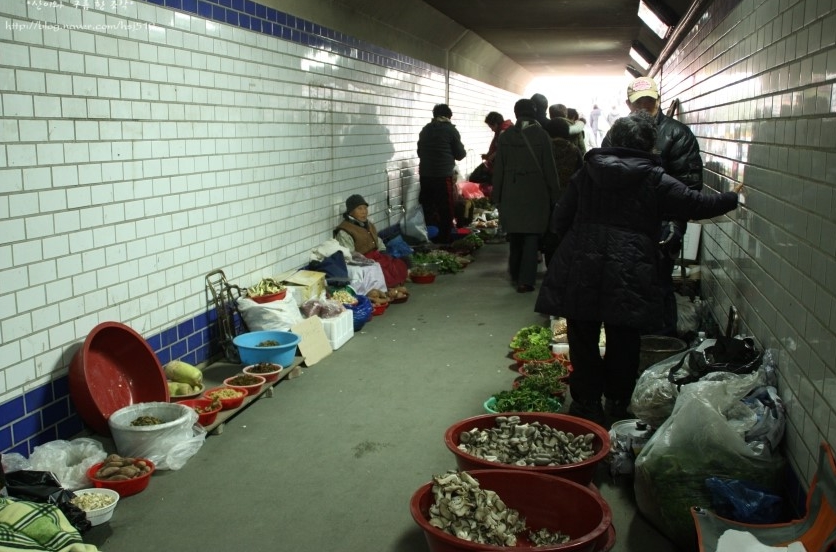
The Shintanjin Open Market is a traditional market that was formed a long time ago. It is held every five days (3rd and 8th) providing a variety of food and attractions. 


The venue ranges from Shintanjin 4 crossroad, underpass, and Seokbongdong Office. The market held on the fifth day is held on Shintanjin open space, spreading out along the left side of the sidewalk, 4 crossroad and on the left of the underpass. On the market date merchants from neighboring areas (Jochiwan, Gongju and Yuseong) come to Shintanjin. Professional peddlers bring clothing, dried fish, and other living accessories, and farmers from the vicinity sell agricultural products they themselves grow


2013년 6월 12일 수요일

[TalkTalk Market] Sinpo Market in Incheon

[Talk Talk Market]
Sinpo Market in Incheon


Sinpo Market is a permanent market located in Incheon, the first Korean port city to open to foreign lands in the modern era. The market was formed spontaneously as new culture and products came into the country from Japan, Qing (present-day China), U.S. and Russia following the opening of the local Jemulpohang Port in 1883. In 1895, a fish market was opened for the first time, and around the same time, Chinese farmers entered the country to sell produce such as cabbages, radishes, onions, tomatoes, and carrots. Once the center of Incheon, the market has now turned into a historical place. For more than 110 years, the market has been such an important cultural and economic center that there was even a saying that “whatever one cannot find in Sinpo Market will not be found anywhere else in Korea.”


The first thing that comes to mind when it
 
comes tSinpo Market is dakgangjeong (fried chicken pieces coated in a sweet-and-sour sauce). The entrance to the market is lined with the best dakgangjeong stores in the country, with people waiting in long queues to get their hands on the fried chicken. Other good eats are the vegetable sundae (Korean sausage), five-colored and steamed dumplings, gukwappang (flower-shaped pastry with a red bean filling), meat dumplings, gonggalppang (crispy bread that is empty inside), and seasoned pork skin, all of which draw in visitors for a tour of the market.


Major shopping items
Dakgangjeong, five-colored dumplings, gonggalppang

Nearby attractions
Jayu Park, Incheon China Town, Dapdong Catholic Church, The Museum of Korea Emigration History

Transportation
Get off at Dong Incheon station on Subway Line 1 and walk about 10 minutes through the underground shopping center until you reach the market.
The trip on the express subway to Dong Incheon is much shorter.


the taste and style of life,
the depth of a traditional market
agency for traditional administration.


2013년 6월 9일 일요일

[Enjoy KOREA] Traditional markets epitomize Korean culture

Traditional markets epitomize Korean culture


Traditional markets in Korea have increasingly become an invaluable tool to bolster the tourism industry.

More tour programs for foreign travelers include a traditional market on their itinerary in an attempt to allow them a glimpse of unedited Korean culture and typical daily life.

The government and merchants have taken advantage of the change in getting rid of long-standings at many traditional markets that were once littered with trash and discredited for the sale of fresh produce kept in unsanitary conditions at unfixed prices.

Behind the achievement is the Agency for Traditional Market Administration (ATMA). It was established in 2005 under the support of Small and Medium Business Administration and is committed to reinvigorating traditional markets and transform them into a tourism magnet projecting the “spirit of traditional Korean culture,” according to a release.

Jung Suk-
youn, director-general of ATMA, said his organization is responsible for establishing an environment where visiting traditional markets becomes a core part of inbound tourism.

“Markets are not a place where people just sell and buy products. It’s a place where the various faces of Korean society coexist,” Jung told The Korea Times at his office in downtown Seoul, Monday. “The core reason for travelling is to see and experience a different culture. I believe no other places are better than traditional market to see real face of the country.”

ATMA will host a variety of events at traditional markets in Seoul,
Busan, and Sokcho for foreign residents and those in Korea on vacation ahead of the Chuseok holiday (the traditional harvest festival), which falls on Sept. 30.

Participants will take a market tour and with the help of Korean advisors buy ingredients for a cooking class to make traditional Korean food eaten during the
Chuseok celebration. Other special activities will include learning how to perform “charye” (an ancestral ritual), a traditional “samulnori” Korean percussion performance, and shop with discount coupons offered by the agency.

“This is a proactive campaign to lure foreign travelers (to markets) and promote our culture,” Jung said. “We still have long way to go. But I’m certain that this small step will create more and more followers and they will eventually make a big stride in improving the value of markets as a tourism asset.”

On top of this, the agency runs a website (www.sijang.or.kr) that contains in-depth information about Korean traditional market. The website is available in English, Chinese and Japanese. In addition, it provides information on the specialties of each market and things to see and do around each one to fuel foreigners’ interest.

“The accessibility of traditional markets was indeed low despite their high value in the aspect of cultural tourism and keen interest of foreigners due to the language barrier,” Jung said. "The website will help foreign tourists take one step closer to traditional markets, and we will continuously upgrade its content that can promote the charm of traditional Korean markets.”

The agency has recently turned to social networking services to promote the nation’s traditional markets worldwide by starting a Facebook page. It also has a smartphone app, available for download via the website.

The Korea Tourism Organization recently joined forces with ATMA by publishing a traditional market guidebook for Chinese tourists in the latest in a series of efforts to revitalize visits to traditional markets in Seoul.

It focuses on the
Gwangjang, Tongin and Gongdeok markets and suggests interesting experiences available there through a format based on SBS TV’s famous show “Running Man.” The book consists of different missions that can be completed by visiting food vendors or different stalls.

ATMA is also held responsible for improving the basic hygiene of markets and merchants. It has hosted a “college for merchants,” in which professionals educate vendors about customer services that have exclusively been available in department stores and discount malls.

“Merchants’ ignorance of customer services has led to a declining popularity of traditional markets,” Jung said. “Many merchants and mom-and-pop store owners are still trapped in the obsolete belief that people will buy products regardless of customer services. But that’s not the case anymore with supply to markets exceeding demand. It’s time for vendors to realize the situation facing them and become self-motivated to change.”